




THIGH LIFT SURGERY
It can occur with various fat and sagging in the upper leg areas, also called thighs, after excess weight loss, after pregnancy periods or with aging. This condition can cause both the patient to be aesthetically dissatisfied and the patient to be uncomfortable while walking and can also disrupt the comfort. For this reason, some patients may need a thigh lift (upper leg lift) operation. There are two types of thigh stretching techniques.
1. Mini Thigh Lift: Technique performed with a short and transverse scar hidden in the groin area
2. Extended Thigh Lift: It is a method of surgery that leaves longitudinal scars called vertical.
Sagging of the outer part of the thigh area, on the other hand, is much rarer and is observed after weight gain after excessive weight loss.
WHO IS THE THIGH LIFT APPLIED TO?
First of all, it is suitable for patients with a body mass index less than 32, with aesthetically unpleasant flabbiness in the inner thigh area. Because the thigh area is a movement area, it is more delicate and requires special care. It is an ideal solution for patients who do not smoke, do not have chronic diseases that will disrupt wound healing.
THE BEST CANDIDATES FOR A MINI THIGH LIFT:
Patients with laxity in the upper 1/3 of the Inner thigh area are suitable candidates for mini thigh lift or short scar thigh lift surgery. These people are usually people who are related to aging, have gained moderate weight, or have sun damage.
THE BEST CANDIDATES FOR AN EXTENDED THIGH LIFT:
Patients who have lost excess weight after extreme weight loss or after stomach reduction surgery are suitable candidates for this surgery. In these people, the incision is made vertically, as it will require tightening from neck to neck in the thigh area. A long scar remains on the longitudinal incision. In the longitudinal scar technique, there is a scar that can be seen from clothes such as shorts or mini skirts. This situation should definitely be taken into account when deciding on this method. However, if this trace is accepted, it is possible to get a thin and taut thigh area. Especially after bariatric surgery operations in which extreme weight loss is observed, there is no other choice but to choose the method with a long scar, as the elasticity of this part is very reduced. Some relaxation is inevitable a few months after surgery.
INCISIONS:
All surgical procedures leave a mark. Plastic surgery aims to hide scars in the least visible parts of the body. There is a thigh lift process in which two different incisions are made:
1. Mini stretching with a transverse (short) scar: The scar starts at the groin fold, goes down and around the back of the hip.
2. Vertical (long) trail-leaving stretching: The trail starts from the inner side of the thigh at the upper level, descends downwards so that it is inside the inner part of the thigh. Sometimes it ends at knee level; sometimes it may end slightly above.
DETAILS OF THE OPERATION:
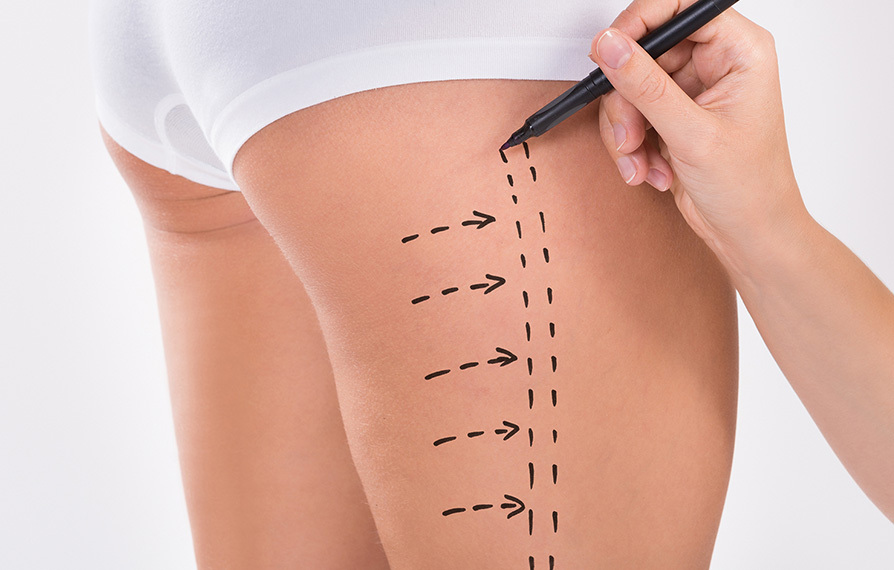
Thigh stretching is performed in two stages. In the first stage, oils are removed with liposuction, and in the second stage, the removal of skin tissue is the stage. Before the operation, a drawing is made in a standing position, the possible location of the scars that will be left at this stage is indicated. The operation is performed under general anesthesia.
THIGH STRETCHING:
In this technique, first of all, liposuction is performed along the entire thigh and the thigh is shaped. liposuction allows the removal of more tissue by narrowing the diameter of the thigh all around. After the liposuction is completed, longitudinal skin tissue is removed from the inner part of the thigh and repairs are made in accordance with aesthetic techniques.
THE HEALING PROCESS:
After the operation, heavy exercise and physical activity are Decommissioned for 1 month. On the evening of the operation, the patient gets up and is carried out by the nurse. A corset is worn after surgery. Since it is performed under general anesthesia, the first day is spent in the hospital. If everything is normal in the next day's control, painkillers and antibiotics are prescribed and discharged. As with any surgical procedure, there is a risk of complications and these risks are quite low.